by KeyTech | Sep 22, 2021 | Business Marketing, Digital Marketing
Your larger competitors seem to have it all worked out, with their consistent, on-brand messages. How can you keep up? Where do you start?
If you haven’t defined a voice for your business, start right there.
A personality for your business is the foundation of a brand. Your voice is the primary signifier of what you stand for, what your culture is like and what impact you create for your customers.
But hold up – those are all pretty abstract things. Why would your small business need all this? Don’t you just make X for people who need X?
Why develop a voice for your small business?
Well, sure, but most local businesses compete against larger enterprises in some way, and those companies have a brand out there in the world busy imprinting their name in the minds of your market. You can, and should, have the same. A voice amplifies your messages, shows people you’ve got it together, and helps them remember you. We talked a little about this in ‘Does your small business really need Branding’?
We also mentioned in our recent post on Marketing Trends for 2022 that personalisation is going to be increasingly important – and having a unique voice for your business is perhaps the best way to achieve a personal fit for your customers.
The good news is you don’t need to find an expensive branding agency. Anyone can work out their own voice. With it you can confidently engage with marketing and social media, or pass that voice on to any marketing help you engage along the way.
And when you’re ready, you can use this voice as the blueprint for a more detailed brand.
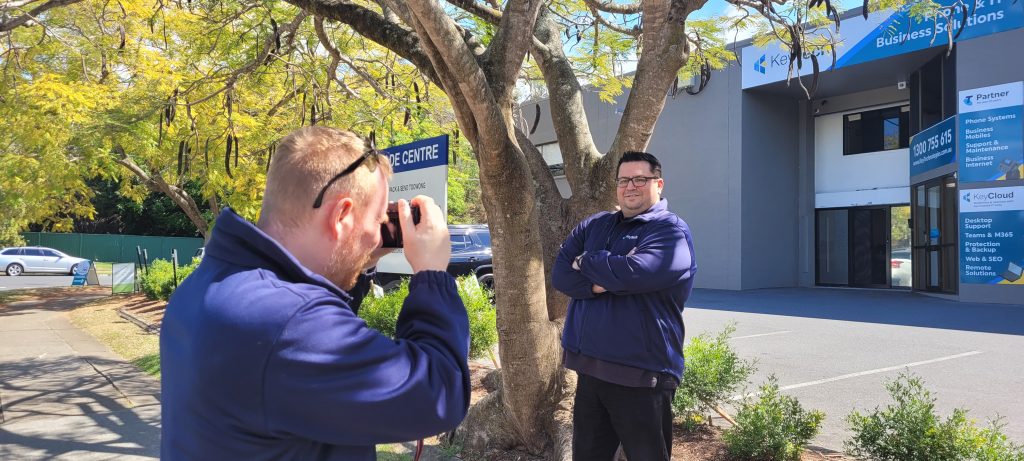
Your voice can inform all of your communications, including graphics and photos. Here’s Alistair and Ben outside KeyTech in Toowong.
Today we’re going to help you work out three things regarding your voice.
Elements of your businesses voice:
- When you speak, how do you sound?
- When you speak, how do you make people feel?
- How do you change your customers’ lives?
The Brand Attributes Exercise
This exercise isn’t that complicated but works better with the whole team in the room. Of course, we’re happy to drop in and run through it with you, but we think you can handle this one. This exercise is adapted from our brand strategy offering (bundled with web design) and we’re spilling the beans today.
How to create a voice for small businesses:
- Get a few of the team around a table and caffeinate them sufficiently.
- On a whiteboard draw up three columns headed Voice, Feeling and Impact.
- In the Voice column, ask your team to list as many words describing your culture as you can. If your business was a person, how. would they sound when speaking? They should be best-case-scenario words (how you want them to be).
- In the Feeling column, you’re looking for words that describe how your customers will feel when dealing with you. Of course, these are likely to be the opposite of the feelings created by the problem you solve, but they might not be. There are no wrong answers, just see how many you can get down.
- In the Impact column, you’re looking for words describing how you’ll change your customer’s life – this could be in small or big ways. See if you can get 20 – 30 in each column. There are no wrong answers, so don’t correct or discourage anyone. You’ll find that some suggestions build on others, some are more general and some are more specific. That’s fine at this stage!
- Now that the columns are full, you’re looking to narrow the list in each column down to the top five. You’re looking for general consensus, but vote if you need to The first three will be easier, and then there will be some discussion as to which are the next most.
- Repeat that process for the top 3 words,
- And then again, to find the single, most important word.
You’ll notice some excitement building in the room as you get into this exercise. It’s as if your business suddenly has a soul. This exercise is always an honour to be a part of, and we think you’ll know why if you try.
Now you have the words you’ll use to create your impact narrative: the guide for your voice. Here’s what ours looks like:

These three triangles represent steps you take your customers on, which can be represented in your voice. You can use this in all your communications and design, calling on either the primary or secondary word to change things up when needed.
You can see from the above that for KeyTech, we want to sound helpful, make our customers feel valued, and ultimately, give them peace of mind, but we can also say that sometimes we sound human, make sure our customers are heard and that we make their life simpler.
It’s important to include impact in your voice because good marketing always includes a prompt to think positively and act proactively on the problem. When we interact with our customers we want them to be conscious of the better tomorrow we’ll help them get to.
Now you have your voice!
The best part is you all had a part in creating it, so it’s 100% authentic and will feel real when people hear it across your social channels, advertising and emails.
If you go through this process, let us know how it went, and what voice you came up with!
by KeyTech | Jun 24, 2021 | Business Marketing, Communications, Digital Marketing
If you are thinking about changing your digital strategy, your actions may include the redesign of your website. You’re probably asking yourself whether it makes sense to invest money in redesigning your website. Will this help you attract new customers? What you must do so that people spend more time on the site?
Your website is your digital showcase. Having a good design and easy navigation will not only let customers reach you, but it will also help you position your brand as one that cares about its customers and is on top of usability trends. In this article, we give you to consider as you think about your website.
1. SIMPLE AND MINIMAL
As a rule, when someone visits your website, they may not spend more than a few minutes browsing it – often as short as a few, seconds. At this time your client must find what they are looking for. So, if your main page is saturated with filler text. Take some time to consider how your key value proposition. Could be better highlighted.
Similarly, think about what you want people to do on this page. This is your call to action. Many websites don’t have a clear call to action or have many conflicting ones, meaning they will be confused. Think about what the one most important thing you want your potential customer to do is.
2. EASY TO CONTACT
That could be as simple as making contact. Whether your business is B2B or B2C, your customer must find an easy way to get in touch with you. That is why tools such as chatbots or calls to action that led to contact pages or phone/email details will give the customer the confidence to do that.
3. COMPLETELY RESPONSIVE
Times have changed and now people will visit your website with their mobile devices. Is yours ready for this? If you haven’t touched it in a while, it may not be. Test it and find out.
This is why it is super important your new design follows a responsive structure and is fully adaptable to the mobile experience. Any website needs to work brilliantly no matter the device used.
In short, if your website is “not responsive”, your competition already has a significant advantage, as Google now gives precedence to websites that.
A great way to check how your web page looks on different devices is responsinator. If you want to do a quick check, Mobile Friendly will also give you the gist of the mobile experience you provide.
4. SPEED DOES MATTER
Website load speed is a key factor in various aspects of your digital presence, including SEO. If your website is slow, there is a good chance it’s either poorly built or using a slow hosting platform, so maybe it’s time for a change. Internet users are not patient: they expect immediate results, just at the click of a button, so we’d better be giving it to them.
If you want to check the speed of your website, you can use Google’s PageSpeed Insights or GTmetrix.
5. Build and follow a brand
It is important that the visuals, whether video, photography, or graphics, reflect the personality of your business. If one thing gives the impression that you have no brand, it’s inconsistent visual. In general, most people want to seem “cool” or new things. Users who are visiting your website are doing so to obtain more information before making a purchase decision. Whatever that decision, your visual resources can make your brand more human and build a real connection with the user.
To have a visually attractive website, you do not need to spend a lot of money or resort to boring stock images. Photos from your own phone will often do, and customers may appreciate the personal approach. Consider bringing in a professional photographer to capture your workspace.
Don’t be afraid to show your office as it is, your staff as they are, or your products (used by real people). These will have manifold more impact than a stock photo that any company around the world could use, and customers can tell.
6. UPDATE YOUR CONTENT
The internet is full of content that used to be relevant, but as the years went on has become out of date. Your content must get updated to suit the era. Businesses change over time too, so it’s even more important that your content is adapted to your current customers by reflecting what matters to them.
For example, imagine that you create a giving SEO positioning advice. Some of these techniques won’t change, but others will become outdated as search engines change their methods. New techniques will have also emerged.
If you don’t update that content, it becomes irrelevant or even misleading. Google and other engines value this negatively, so you’re your website will lose its hard-won search engine ranking and ultimately provide you fewer leads, and revenue.
You must also bear in mind that your content needs, internal and external links, proper use of keywords, etc. If you are missing these elements, it’s time to update it. Link’s a change or disappears over time, so even if you do have them, it’s worth making sure they’re up to date!
7. SEO OPTIMIZATION
One of the most constant and lasting marketing strategies that you will have is your SEO strategy. It is very important to work on your keywords and adapt the content of your website to your SEO strategy. This will bring you organic (free!) traffic and improve your position with the search engine, otherwise known as your ranking. This is how you get to that prized ‘page one’.
Without a doubt, the SEO optimization of your website is vital for it to be a productive part of your marketing strategy.
Here’s a breakdown of the key elements of SEO:
- The loading speed of the pages.
- The use of friendly (human-readable) URLs.
- The inclusion of metadata, especially titles and, descriptions.
- The addition of an intuitive and navigable sitemap with content that can be easily indexed in search engines.
- Good site usability is achievable with the redesign of web pages, especially the navigation.
- Optimization and updating of all content.
- Fixing possible broken links (these are seen by the search engines and will drag down your ranking).
Considering these tips, these would be the steps you have to take to meet your goals when redesigning your website:
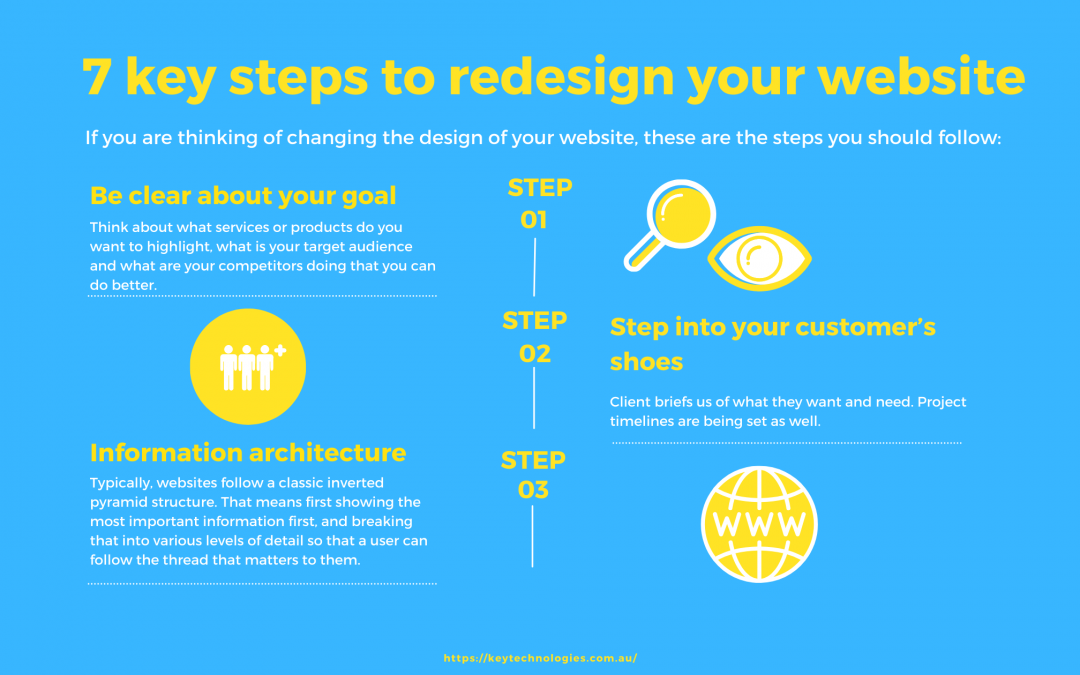
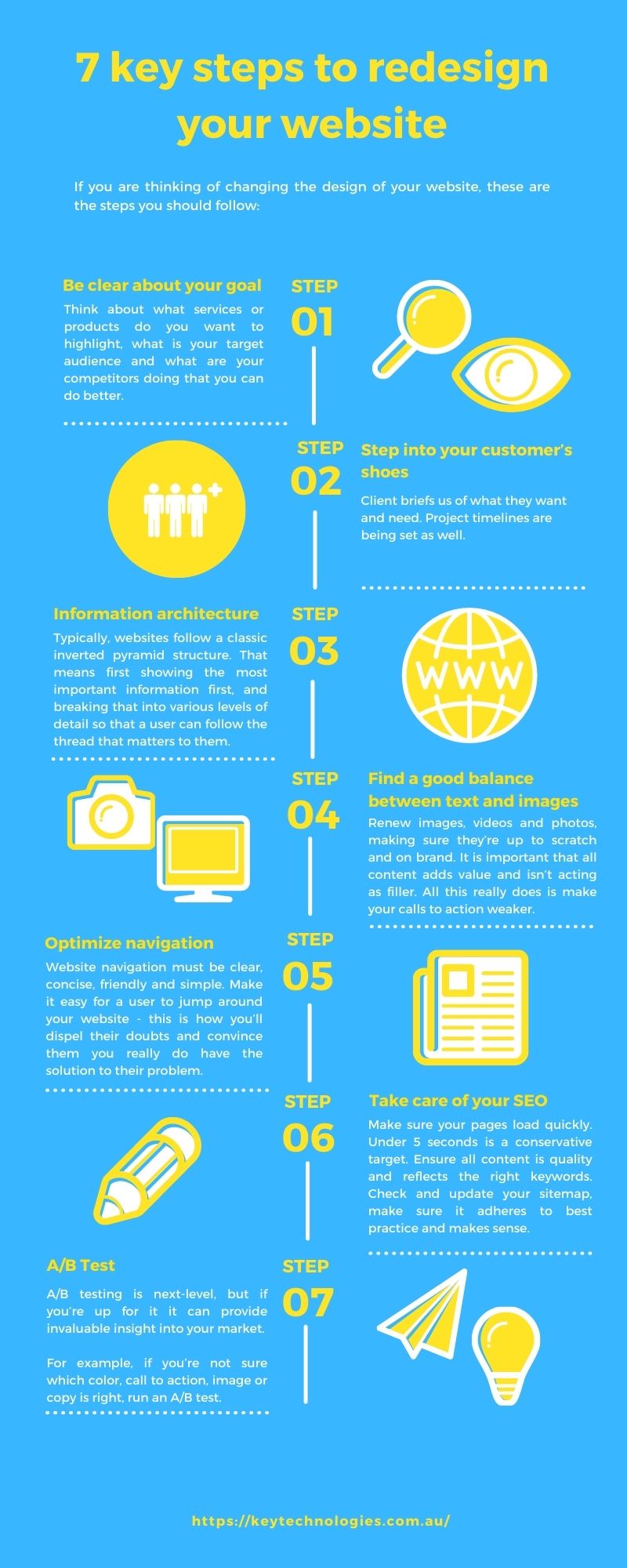
1. Be clear about your goal
Your first step will be to work on your goals. Ask yourself a few questions: What services or products do you want to highlight. What is your target audience? Which pages get the most visitors currently – are these the right ones? What are your competitors doing that you can do better?
2. Step into your customer’s shoes
Now that you’ve thought about what customers use your website for, consider how they’re going to use it. Is it easy for them to visit pages with the information they’re looking for?
3. Information architecture
This will lead you to a review of your information architecture. Typically, websites, follow a classic inverted pyramid structure. That means first showing the most important information first and breaking that into various levels of detail so that a user can follow the thread that matters to them.
4. Find a balance between text and images
Renew images, videos, and photos, making sure they’re up to scratch and on-brand. It is important that all content adds value and isn’t acting as filler. All this really does is make your calls to action weaker.
If the visuals aren’t consistent, it might be better to not have any at all, to protect the integrity of your brand identity.
Remember, less is more on a website. Always look at content from the perspective of your customer. Is it helping?
5. Optimize navigation
Website navigation must be clear, concise, friendly, and simple. Make it easy for a user to jump around your website is how you’ll doubt and convince them you really do have the solution to their problem.
6. Take care of your SEO
Make sure your pages load quickly. Under 5 seconds is a conservative target. Ensure all content is quality and reflects the right keywords. Check and update your sitemap, and make sure it adheres to best practices and makes sense. Ensure all pages have the right metadata in their titles, tags, and descriptions. Make sure URLs are human-readable (but ensure they redirect to new URLs if you change them).
7. A/B Test
A/B testing is next-level, but if you’re up for it it can provide invaluable insight into your market.
For example, if you’re not sure which colour, call to action, image or copy is right, run an A/B test. You can run these as long as you like and collect data that will help you understand your customers better and optimize the website for them.
If you’re still not sure…
If after reading this article you’re still not sure what to do with your website, please that, redesigning your website is to invest in your most important digital asset.
In essence, a website is a communication tool. If your potential customers cannot communicate with you through your site, you’re missing out on revenue.
We’re here to help. If you need a professional eye on your site, we’d be happy to take a look and let you know what needs attention.

by KeyTech | Jul 24, 2015 | Business Marketing, Cloud, I.T., Solutions
Looking at upgrading your business PCs to Windows 10 but not sure when to do so?
Volume licensing customers will be able to download Windows 10 Enterprise and Windows 10 Education on Volume Licensing Service Center from 1 August
Windows 10 arrived 29 July
According to the experts the standard policy of waiting for the first service pack to arrive before rolling out a new Operating System is now no longer needed, but some may still prefer to wait for it to mature a little before they jump in.

Companies should wait until it’s clear if the line of business applications they use work happily with Windows 10, and whether they can find enough expertise to make sure any rollout is a smooth one. “All of that has to build up before you want to jump in and start running it in your production environment,” Stephen Kleynhans, research vice president at analyst Gartner said.
Kleynhans said businesses need to spend some time testing out Windows 10 in a controlled fashion: “Bring it into a lab, bring it into a test environment, let some folks run it for the rest of this year. Then, in 2016, get serious about it, start looking at it in a real test environment, start piloting it with some real users to see how it’s performing.”
He said that if all goes well companies should be ready to start deployments in the second half of 2016 or the beginning of 2017, depending on how large and complex their IT environment is.
As Ed Bott notes over at Tech Pro Research, other missing features will include the new unified sync client for OneDrive (the consumer cloud storage service) and OneDrive for Business (the cloud storage service for business Office 365 subscriptions). He predicts these will be wrapped up by late October, in time for Windows 10 PCs to hit the retail channel for the festive season.
Other factors to consider: at a prosaic level, the upgrade will inevitably cause disruption so don’t plan it for a busy time of year. If you’re in retail, starting the upgrade in November or December might be a career limiting decision for the CIO.
The state of your current infrastructure is another element to take into account. Gartner says that companies planning Windows 8.1 deployments should instead redirect their efforts toward earlier deployment of Windows 10.
“In almost all cases, enterprises currently planning to deploy Windows 8.1 should switch to Windows 10. Enterprises that already have Windows 8.1 deployed should continue with those deployments for the time being. Customers on Windows 7 with no plans for Windows 8.1 should begin evaluating Windows 10 for deployment in 2H16 or later,” the analyst firm said in a research note.
Equally, for some, the upgrade may never take place. David Gewirtz has no plans to upgrade any of his Windows 7 devices to Windows 10: “They work, they’re rock solid, and all their drivers are perfectly tuned to the hardware they’re running on,” he notes.
However long enterprises will take to change over, Windows 10 is likely to become widely adopted, if only because most firms will need to move off of Windows 7 eventually, while the relatively few who did move to Windows 8 will also update sooner rather than later. The pressures that forced companies to migrate off Windows XP and onto Windows 7 will eventually make them move from Windows 7 to Windows 10.
“Windows 7 comes to end of life in January 2020. That’s only four and half years away so you’re going to see the same sorts of pressures mount to get off of Windows 7. They need to go somewhere and they’ll go to Windows 10,” he said.
Talk to the Key Technologies team on 1300 755 615
If you are interested in a truely integrated business

by KeyTech | Jan 14, 2015 | Business Marketing, Solutions
Running a business is a challenge, and success does not come easy, nor is it guaranteed.The degree of competition for your consumer’s dollar is fierce, and majority of business owners work damn hard dividing their efforts between running their business and generating sales to build their business. More often than not, growing a business using this hands-on, hard-work approach affords very little time for a holiday, much less, time to explore efficiency improvements.
Unless a strategic change is made to re-position your business to leverage opportunities with less effort for equal or larger returns, the hands-on, hard-work grind will continue.
Cleansing your business and building a well-oiled machine begins with examining how you do business, starting with the following questions…
1. How does your business differ from the competition?
Don’t be a sheep – If you are one of a number of businesses offering the same products and services then it is only a matter of time before your customers gravitate toward the cheapest price (which will equate to more effort for less return). Focusing on what your business does better than anyone else or carving a niche within your existing industry can shift your customers focus from price to something more experiential.
Consider The Shaver Shop vs. Dollar Shave Club – The Shaver Shop sells products readily available from retailers, department stores and supermarkets, whereas Dollar Shave Club has focused on a single product – Great Razors, One Low Monthly Fee, No more forgetting to buy your blades. A shift in focus enabling this start-up to experience phenomenal market growth with an industry that many would argue as saturated.
2. Are you systems orientated?

As a business owner you will likely fulfil many roles within your business, systemising your business processes will ensure those roles required for the day to day running of your business remain manageable and do not take you away from the important task of growing your business.
A systemised process will also provide a benchmark for efficiency improvements as more time becomes available or as the business expands and new team members are brought in to support the growth of your business.
With clearly defined business functions, software applications that can automate these processes become easy to source and can deliver efficiency gains at a minimal cost as your time grows more valuable.
3. How connected are you?

Technology improvements are minimising the gap between small and large business, remaining connected is essential in a society where instant gratification is still not enough to satisfy clients.
To quote Sun Tzu “To rely on rustics and not prepare is the greatest of crimes; to be prepared beforehand for any contingency is the greatest of virtues.” With timing of critical importance the success of your business hinges on the cohesive performance of all areas of your business including, but not limited to advertising performance, customer inquiry handling, production, inventory management, cash flow, logistics, order tracking, customer satisfaction reporting etc. Many of these business functions can be managed with a handful of clicks or completely automated requiring less effort for your business to output more.
There is no shortage of technology options that can deliver productivity improvements for business, a great article on Integrating your Smart Phone with your business for Productivity Gains includes plenty of examples and depending on your business requirements, an ‘off the shelf solution’ or customised application can be sought.
4. How would you rate your online identity?

The internet has had a huge impact on a customer’s decision making process, providing instant access to service providers and information about pricing, availability, alternatives, promotions and so much more. With online activity such a heavy influencer on customer purchasing decisions, reviewing your online presence is a must.
An out-of-date website, empty blog and neglected social media accounts will slowly poison your business. If your website is difficult to navigate or is not responsive to the multiple devices your potential customers are using to investigate your business, it is unlikely you will even be considered for their business. A case study by Marketing Sherpa found that a website redesign for one company resulted in a 21.6% increase in conversions. Regular website updates and content additions can keep your businesses online presence relevant and at the forefront of your consumer’s investigations.
An up-to-date website, done right, will deliver more inquiry for the same (or less) advertising spend.
5. Are you leveraging your Strengths?

Use your size to your advantage! Being a small business means you can react far quicker than your larger counterparts who have to negotiate red tape and internal bureaucracy before shifting to meet changes in the market place.
The more you know about your customers and market place, the better chance you have at satisfying their needs and building loyalty. Simple questions can provide you with invaluable information.
Smaller businesses benefit from flatter business structures and smaller teams, make use of your face time with clients to deliver personalised service that large faceless corporations could never compete with. Building a strong relationship with your customers will reduce price sensitivity, reduce advertising / marketing costs, reduce client acquisition costs and shift the focus to more important experiential factors that will keep your clients returning and referring.
The Bottom Line
Continuing to work harder for diminishing returns means you eventually there won’t be a business. A concentrated effort is required by business owners, with the involvement of staff, to determine what strategic shift is required to transform a business to deliver greater returns from equal or reduced effort.
Where to start?
Talking to the professional team at Key Technologies will ensure a cohesive approach, combining I.T. with Communications experience to deliver a truly integrated solution for your business.
Contact the Key Technologies team – 1300 755 615
If you are interested in a truly integrated business

by KeyTech | Nov 27, 2014 | Business Communications Solutions, Business Marketing, Solutions
How do you market your business? Are you taking advantage of every opportunity to inform your clients and prospects of your services, USPs, achievements, promotions? There is a difference between putting your customers on hold vs. placing them on hold and providing them with useful information.
[shareaholic app=”share_buttons” id=”12025595″]
- 70% of business callers are put on hold.
- 60% of business callers that are placed on hold HANG-UP.
- 30% of these callers DON’T CALL BACK!
Considering the majority of advertising budgets for business is focus on getting the phones to ring, what are you doing to keep them on the line?
- Callers with SILENCE-ON-HOLD will abandon their calls in less than 60 seconds, and 90% hang-up within 40 seconds.
- Callers with MUSIC-ON-HOLD will stay on the line 30 seconds longer than silence.
- Callers with INFORMATION-ON-HOLD will stay on the line for up to 3 minutes longer.
With an average of 70% of all calls placed on hold, if someone has taken the time to contact your business you can’t afford to leave them hanging.
A Marketing Opportunity is Presented
A simple way to keep customers engaged when on-hold, and increase sales, is to provide useful information about your business.
Your business can use on-hold advertising to…
- Promote your social media presence
- Cross sell profitable products
- Promote new products or services
- Deliver your unique service proposition
- Tell your customer why you are different
- Reinforce newsletters and other marketing material
- Tell customers about your latest news
- Boost your brand identity
- Drive traffic to your web site or on-line store
On-hold advertising provides a very inexpensive and automated method for marketing your business.
First impressions count, as does every interaction
What first impression are you providing to new and existing customers? Delivering a professional blend of music and message demonstrates a level of professionalism that will set you apart from your competitors and for small business, make your company sound like a large corporation.
Where to start?
We have implemented on-hold advertising for many Brisbane business clients, along with providing qualified marketing advise to ensure our clients businesses are growing.
Contact the Key Technologies team – 1300 755 615
If you are interested in maximising your business marketing efforts or to inquire about on-hold advertising